In the mid-1990s, Ramon Viñals i Soler, a businessman and politician from Barcelona, was charged with the task of reviving masonry in the Balearics. Twenty years on from the death of Franco, masonry was still very much in the doldrums on the islands, and this despite the fact that it had briefly thrived in the years leading up to the Civil War. Whether it can be said that Viñals was successful is open to question. In March 2010, Mallorca was turned into the capital of Spanish masonry. The Grand Lodge of Spain made the Hotel Meliá Victoria in Palma its centre for the gathering to elect the new Grand Master; there was also voting in other parts of Spain. Some 300 votes were cast at the hotel, of which 253 were by members from the Balearics, which was a healthy proportion of the total number of masons - 400. However, fifteen years on from the start of the revival campaign, the number didn't really appear to have represented a great success.
At this year's assembly of the Grand Lodge in Madrid, Oscar de Alfonso Ortega was re-elected as Grand Master. He had one opponent: Ramon Viñals i Soler. 592 votes were cast. Alfonso secured 92% of the vote, an overwhelming majority which might have seemed odd.
Alfonso had been a surprise winner in 2010, dislodging (so to speak) the "official" candidate, José Carretero. It was said that his victory owed a great deal to support from British masons, of whom it was reckoned that they comprised roughly 50% of the voters. By the time of this year's vote, however, Alfonso's British support was believed to be in decline, while he had also lost favour among Spanish masons. This was because a Jesuit scholar had been invited to a masonic meeting and had been given an award by Alfonso; the Jesuits had once been to the fore in the persecution of masons. Alfonso had also publicly defended a drug-dealer who had been on a British list of the top ten most most-wanted criminals. Yet, when it came to the election, he came romping home.
So, how might this victory be explained? Viñals was and is, after all, a veteran mason, but his politics and his associations might well have let him down. His political career has been defined by his socialism and his republicanism. He is a supporter of Catalonian independence, but his interests stretch beyond Spain. To the Sudan, for instance. He has been a "goodwill ambassador" in Europe for Omar al-Bashir, the president of the Sudan, for whom there is an arrest warrant issued by the International Criminal Court.
Whatever the reasons for Alfonso's stunning re-election, it would seem that the upper echelons of the Grand Lodge have been tainted with controversy in the recent past, and, perhaps as a sign of a fierce rejection of Viñals, Alfonso's re-election led to a strong statement of loyalty to the King, the Crown and the Constitution being issued. Yet, despite Viñals' republican views, this political affiliation was responsible for what was the only short era when masonry assumed a position of some importance in the Balearics and in Spain.
The origins of the islands' masonry can be found in Menorca, the consequence of British influence on the island. As a movement it first surfaced in the 1830s, came to Mallorca briefly, disappeared, returned, entered a period of crisis in the late nineteenth century when it all but disappeared again, only for it to resurface during the Second Republic of the five years before the Civil War: over 80% of Republican deputies at the Cortes parliament were masons.
On 15 September 1936, so only weeks after the start of the war, freemasonry "and other clandestine activities" were declared illegal by Franco's Nationalist rebels. By 1938 there was a "Special Tribunal for the Repression of Masonry and Communism". With their deeply conservative Catholicism, the Nationalists and the Falange took their lead from the Church, which had been railing against masonry for decades. How many masons were executed or murdered is impossible to say. A list of 80,000 so-called masons was drawn up by Father Tusquets, the mason-witchfinder-general. There were in truth only around 5.000 masons in Spain at the time.
The regime left its legacy, and masonry remained dormant until Viñals sought to revive it. The number of masons in the Balearics may be low, but then there are reckoned to be fewer than 7,000 masons in Spain as a whole; England is said to have a quarter of a million. But maybe its popularity will grow. The Grand Lodge doesn't admit women, but the Symbolic Grand Lodge does; the Sapere Aude ("dare to know") lodge was established in Palma in February. Traditions hold though. Even Viñals, a more liberal mason, is against women joining the Grand Lodge.
Showing posts with label Franco regime. Show all posts
Showing posts with label Franco regime. Show all posts
Tuesday, October 28, 2014

Monday, October 27, 2014
The First Industrial Estate In Spain

Once called Son Perera, Son Castelló has a long history. A certain Joan Castelló acquired the finca in 1578. He was from a family of tanners: industrialists of yore. Ownership of the estate was handed down to family members over the centuries until, in 1952, it became the possession of family relatives, the Roses Montis brothers. In 1955 they set about selling off the estate, and ten years later 84 "quarterades", valued at 53 million pesetas, were bought by the Associació Sindical d'Indústries de Mallorca, otherwise known as ASIMA, an organisation that had been established for the purpose of promoting industrial enterprises. On 3 November 1967 the polígono industrial was opened. It was the first privately owned industrial estate anywhere in Spain, and its first president was one of its founders, Ramón Esteban Fabra, whose name is intimately linked to Son Castelló and to ASIMA, which this year has been celebrating its fiftieth anniversary.
To mark its fifty years, a book was published in the spring which, replete with photos, anecdotes and factual information, charted its background, and it is a story that is one of the most remarkable in the history of Mallorcan business, because what ASIMA did was to break the mould of how Spanish business operated.
Fabra and his contemporaries were considered to be crazy and idealists. In 1964, despite the free-market liberalism that the technocrats of Opus Dei had presented to Franco as an alternative to the disastrous insularity of autarky, business was still dominated by the concept of organising workers and employers within vertical structures. While this system had been conceived as a means of supposedly keeping unionism and worker discontent at bay, it was one which favoured large businesses and created an environment that did not incentivise new business. ASIMA rejected the system. It not only developed Spain's first industrial estate, it also became the first genuine business association in Spain, and its idealism was founded on precisely those things that the vertical structure inhibited: enterprise, initiative, innovation, entrepreneurship.
ASIMA was to go on to involve itself in other projects. In a way it borrowed from the Victorian ideas of British companies like Lever and Cadbury in that it created social housing for workers and donated land for the building of a secondary school. But it also created the first proper training school in Spain and the first system of what nowadays might be referred to as "incubators" for entrepreneurial ideas and innovation. And overseeing these developments was the visionary, Ramón Esteban Fabra.
The tale is told of how Fabra went to Madrid to present his ideas. He was greeted with suspicion. Having a space for all sorts of trades and professions, having an association for them, giving them the room to grow and develop just wasn't how things were done. The greatest obstacle he faced wasn't so much the government but the Falange. It had been the driving force behind the vertical structure and adhered strictly to the notion of the supreme unity of Spain. Fabra appeared to be proposing something which went against this. In the end, he was able to convince the sceptics in Madrid that laws on labour and on "Spanishness" were not going to be broken. There was agreement but there was Francoist insistence that the industrial estate be called La Victoria; Son Castelló would have been too "un-Spanish". It was only when the regime ended that the original historical name Son Castelló was adopted.
I have argued previously that far from being insular and parochial, Mallorcans, in terms of business at any rate, have long been outward-looking and entrepreneurial. They have had to be because of geography. Tourism brought with it businesses that are now global brands, like Meliá, but the story of Son Castelló shows that the business instinct was wider than tourism. Indeed, the very fact that it was founded at the same time as tourism boomed demonstrates that there were those who appreciated that tourism could do only so much for the economy: businesspeople and not politicians.
There is a twist in this story. A mystery. In February 1983 Fabra went missing. His body was found in the sea off Magalluf. There was no sign of violence. He was clothed except for his trousers. He had drowned, but there was, from what I can make out, no good explanation why. He was 55 years old. ASIMA wanted Son Castelló to be renamed after him. Officially it is. But everyone knows it as Son Castelló.
Photo: Ramón Esteban Fabra, found from an article which would appear to have been published in "Ultima Hora" on 26 February, 1983.
Sunday, March 17, 2013
The Bikini Revolution
When three years ago the right-wing Instituto de Política Familiar (family policy institute) was seeking a ban on toplessness on Mallorca's beaches, the responses were loud in their condemnation of such prudishness. Among these responses were those which made a connection between the attitudes of the institute and Opus Dei. As is probably well understood, it was members of Opus Dei who were to the fore in guiding the economic policy that was to transform Spain in the 1960s. But as part of the drive towards tourism that formed a key element of this policy, it is most unlikely that committed Catholic fundamentalists, such as Opus Dei members, would have approved of certain manifestations of this tourism. And the bikini was one of them.
In 1960, Brian Hyland had a hit with "Itsy Bitsy Teeny Weeny Yellow Polka Dot Bikini". At the same time as Hyland was to be heard crackling out of Radio Luxembourg, the then mayor of Benidorm, Pedro Zaragoza, was facing the prospect of being excommunicated from the Catholic Church, having, in 1959, signed a municipal order permitting the wearing of bikinis on the resort's beaches.
Zaragoza's order flew firmly in the face of Francoist Spain's national catholicism. It was the first such order. It caused an uproar. The Guardia Civil attempted to make beachgoers cover up, Zaragoza decided to take on the church, met Franco personally and, remarkably enough perhaps, Zaragoza was spared the fate of excommunication and the bikini was saved.
The bikini has assumed a legendary status in Spanish history. Under national law, a dress code had been established for the seaside. It required men to cover their chests and backs and women to wear skirts. Elements within the church tried to persuade the Franco regime to go so far as to segregate beaches into male and female sections. It was against such attitudes and legislation that the bikini was to cause the fuss that it did and to come to represent something of a "glasnost" moment in moving Spain in a more relaxed direction.
In reality, the regime was more concerned with guarding the morals of the locals than it was with what tourists chose to wear or not wear. And it was how the bikini was dealt with that explains an awful lot about how Mallorca and the Costas Brava and Blanca (the Costa del Sol was comparatively insignificant at the start of the 1960s) accommodated the pioneering mass tourists and about how Spain was in fact governed.
As part of the Stabilisation Plan of 1959, the one that set Spain on the road to the performance of the economic miracle which occurred, a plan for tourism, and one that came with regulatory backing, had been mindful to attempt to spread the tourism load across the country. The plan was never implemented, mainly because it was almost totally ignored. At the start of the 1960s, almost 70% of all accommodation for tourists was on the two Costas and in the Balearics (most of this in Mallorca).
This disregard for legal measures typified the way in which the Franco regime said or enacted one thing and allowed another to happen. Speculators ruled the coasts of Mallorca rather than legislators, and these speculators were responding to the new demand for sun and beach holidays. In a sense, there was a government within a government that was sanctioning this. Manuel Fraga, the minister of tourism and information and the man widely credited with having overseen the tourism boom, acted more or less as he wanted. Fraga was permissive in all sorts of ways. He was a liberal in Francoist terms, and it was he who not only appreciated that a freer market (brought about by the Stabilisation Plan) should determine where tourism development would occur and how it would occur, he was also the one who rejected puritanical notions that might deter the new tourists.
The regime, once Zaragoza had forced the issue in Benidorm, abrogated its role in determining beach morality. The commonly held view that everything was controlled by central government at that time couldn't have been further from the truth. It was left to local authorities to do as they saw fit, and usually this meant little or no controls over development and instructions to the police to leave bikini-clad females alone. And this despite the fact that the morality law determining beach attire remained unrepealed.
The bikini did denote something of a revolution, but in fact it was more a case of representing the regime's opportunism. A more gracious word would be flexibility. However one wants to describe it, the bikini provided a watershed moment. The beaches of Mallorca were never to be the same again.
Any comments to andrew@thealcudiaguide.com please.
In 1960, Brian Hyland had a hit with "Itsy Bitsy Teeny Weeny Yellow Polka Dot Bikini". At the same time as Hyland was to be heard crackling out of Radio Luxembourg, the then mayor of Benidorm, Pedro Zaragoza, was facing the prospect of being excommunicated from the Catholic Church, having, in 1959, signed a municipal order permitting the wearing of bikinis on the resort's beaches.
Zaragoza's order flew firmly in the face of Francoist Spain's national catholicism. It was the first such order. It caused an uproar. The Guardia Civil attempted to make beachgoers cover up, Zaragoza decided to take on the church, met Franco personally and, remarkably enough perhaps, Zaragoza was spared the fate of excommunication and the bikini was saved.
The bikini has assumed a legendary status in Spanish history. Under national law, a dress code had been established for the seaside. It required men to cover their chests and backs and women to wear skirts. Elements within the church tried to persuade the Franco regime to go so far as to segregate beaches into male and female sections. It was against such attitudes and legislation that the bikini was to cause the fuss that it did and to come to represent something of a "glasnost" moment in moving Spain in a more relaxed direction.
In reality, the regime was more concerned with guarding the morals of the locals than it was with what tourists chose to wear or not wear. And it was how the bikini was dealt with that explains an awful lot about how Mallorca and the Costas Brava and Blanca (the Costa del Sol was comparatively insignificant at the start of the 1960s) accommodated the pioneering mass tourists and about how Spain was in fact governed.
As part of the Stabilisation Plan of 1959, the one that set Spain on the road to the performance of the economic miracle which occurred, a plan for tourism, and one that came with regulatory backing, had been mindful to attempt to spread the tourism load across the country. The plan was never implemented, mainly because it was almost totally ignored. At the start of the 1960s, almost 70% of all accommodation for tourists was on the two Costas and in the Balearics (most of this in Mallorca).
This disregard for legal measures typified the way in which the Franco regime said or enacted one thing and allowed another to happen. Speculators ruled the coasts of Mallorca rather than legislators, and these speculators were responding to the new demand for sun and beach holidays. In a sense, there was a government within a government that was sanctioning this. Manuel Fraga, the minister of tourism and information and the man widely credited with having overseen the tourism boom, acted more or less as he wanted. Fraga was permissive in all sorts of ways. He was a liberal in Francoist terms, and it was he who not only appreciated that a freer market (brought about by the Stabilisation Plan) should determine where tourism development would occur and how it would occur, he was also the one who rejected puritanical notions that might deter the new tourists.
The regime, once Zaragoza had forced the issue in Benidorm, abrogated its role in determining beach morality. The commonly held view that everything was controlled by central government at that time couldn't have been further from the truth. It was left to local authorities to do as they saw fit, and usually this meant little or no controls over development and instructions to the police to leave bikini-clad females alone. And this despite the fact that the morality law determining beach attire remained unrepealed.
The bikini did denote something of a revolution, but in fact it was more a case of representing the regime's opportunism. A more gracious word would be flexibility. However one wants to describe it, the bikini provided a watershed moment. The beaches of Mallorca were never to be the same again.
Any comments to andrew@thealcudiaguide.com please.
Sunday, March 03, 2013
The Mystery Of Club Med In Alcúdia
The Swedish part of this equation I can understand, but the Belgian part has always been less understandable. Belgium, unlike Sweden, is not considered to be an especially important market for Mallorca. Nevertheless, Belgians obviously do come to Mallorca and have done for years, but why Alcúdia?
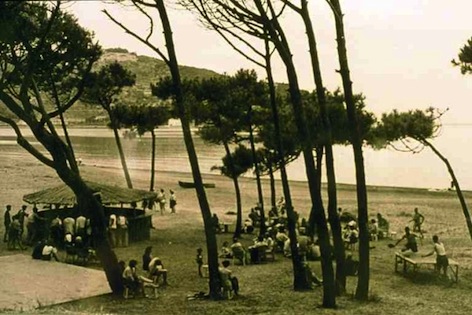
I am only guessing that the Belgian association has something to do with the origins of the devil's work of the contemporary holiday, the all-inclusive. And for these origins, one has to go back to 1950. It was then that the Belgian Gérard Blitz invited the first holidaymakers to a tented camp on a part of the beach in Alcúdia - the Playa de los Francesos, as it became known. It was an all-inclusive experience only in the loosest sense of the term. The holidaymakers all mucked in, there were communal facilities, including sporting ones, food was included in the price of the holiday, and they were the pioneers in having a holiday under the banner of what was to give the world the all-inclusive - Club Méditerranée - at the earliest "holiday village".
The story of Club Med first pitching up and pitching on a beach in Alcúdia is well enough known. What is also well enough known is that Blitz got hold of tents supplied by Gilbert Trigano, who became Blitz's partner and boss of Club Med. It is also known that Blitz came up with the idea for holiday villages having experienced the Olympic Club tent village in Corsica where, apparently, he registered the Club Méditerranée name. But apart from these familiar parts of the story, very little else is known, and so a number of questions arise.
The first one is - where was the holiday village? Playa de los Francesos is a name that one can find references to today but it is not a commonly used name. Going on nothing more than an old photo, I would place the Playa de los Francesos of the holiday village as having been roughly where the Sunwing Resort now is.
Secondly, how long was it there and did it come to consist of straw huts, as became a Club Med trademark? It existed for around ten years before it was relocated to Porto Petro at the start of the 1960s. The site there is no longer a Club Med, Blau Porto Petro Beach Resort having replaced it some years ago. As for any straw huts ... .
The final question is a more difficult one - why was the original Club Med created in Alcúdia? Indeed, why was it in Mallorca or Spain at all? Gérard Blitz was a socialist and had been a Jewish resistance fighter during the Second World War, as had been Gilbert Trigano who, for a time, had also been a communist. Yet, here they were with a holiday village in Francoist Mallorca where, as with the rest of Spain, the regime at that time was not well-disposed to foreigners, of whatever political persuasion or from wherever they might have originated, having a business presence. (It took the Americans to batter down the doors of the regime's reluctance to allow foreign investment in tourism.)
The Club Med philosophy of egalitarianism was a reflection of the founders' values. Though Club Med was to later acquire a reputation for a certain lack of, how can one put it, inhibition, it was doubtless there from the very beginning. It owed at least something to the French naturist movement, albeit without the nudity (or maybe there was). Such egalitarianism and libertarianism would have been totally out of keeping with the regime's attitudes and Mallorcan societal attitudes of the time.
Notwithstanding these apparently conflicting perspectives, Alcúdia as the location for the village may have been the consequence of pre-Civil War ties with Air France. Its seaplanes used to drop passengers off in the bay of Alcúdia en route from Marseille to Algeria. In the early 1950s, Air France was active in developing tourism through its routes from both Paris and Brussels to Palma, though this doesn't answer the question as to why Alcúdia.
Club Med in Alcúdia is all a bit of a mystery. I can find no references to it from 1950 until it was relocated; nothing as to what it may have become during those ten years or as to the reason why it came to be in Alcúdia. There must have been more to it than Blitz just simply having turned up one day. But what that more might be, I honestly couldn't say.
* The photo comes from an entry by Ignacio Gil at: http://www.acttiv.net/blog/club-mediterranee-cumple-60-anos
Any comments to andrew@thealcudiaguide.com please.
Subscribe to:
Posts (Atom)


