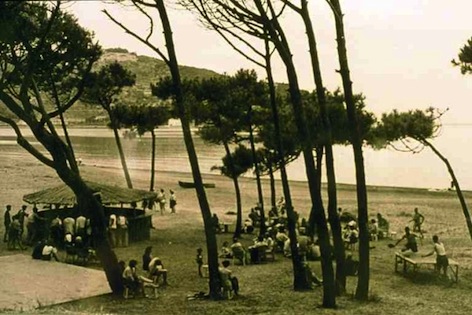
Once upon a time, no one really worried about what you might put on a beach. Even if there were regulations, which generally there were not, there were unlikely to be too many officials around to ensure that regulations were being adhered to, while any who might have been would probably have been only too happy to have accepted an invitation of some folding pesetas and looked the other way.
So it was, for instance, with the tents that were put up on the French beach in Puerto Alcúdia. The beach came to be known by this name, though it was actually a Belgian who was responsible. He was Gerard Blitz, and the tents were those of Club Méditerranée. How Blitz came to choose Alcúdia for the original Club Med, how he was able to get permission to put the tents up, I have no idea, though it is not for want of trying to find out: Club Med themselves don't really seem to know. But tents there were in 1950. The story of Club Med in Alcúdia is blurry to say the least. It would seem that it only lasted two summers, and in 1951, rather than tents, there were more solid structures. They were referred to as "stone", but they had roofs of the style that was to become associated with Club Med - a thatch. And reed for a thatch is abundant in the Albufera wetlands, of which there was a great deal more in 1951 than there is now.
It wasn't officialdom that did for Club Med in those early years, it was the clergy. They weren't bothered about what was being put on the beach, but they were bothered about the lack of clothing of those who were inhabiting the beach accommodation. It was to be some years before Club Med were to get a permanent base in Porto Petro.
It is the thatch, though, which is central to today's story. As also is putting things on beaches. In the days when no one took much notice, a temporary structure could appear: right on the sand. The beach bar was born, and it had its own name - the chiringuito.
As with the uncertain history of Club Med, so the chiringuito's history in Mallorca is one of competing versions. It is claimed that the first one appeared on the eastern coast in S'Illot at a time, around 1953, when there was virtually nothing else there. But whenever or wherever it was, the chiringuito was to become established, as was its image - the one with the thatch for a roof. In the collective consciousness and memory of the beach holiday, the thatch - be it for a sunshade or a chiringuito - is as symbolic as the sand, the sea and the palm tree.
The first ever chiringuito in Spain, so legend has it, was in Sitges, and it appeared as long ago as 1913. There were to be later ones, such as in Torremolinos. These were apparently upside-down fishing boats with presumably some thatch affair, and from these improvised structures, the wives of fishermen would sell fish dishes and beers to tourists of the 1940s. There may be something in this story, as chiringuitos did tend to have a shape that was reminiscent of a boat.
The word itself comes from the Caribbean. A "chiringo" was a measure of coffee that was served to workers on the sugar plantations of Cuba, and so the bars where the coffee was to be had was named a chiringuito. There is a less specific theory that "chiringo" was a generally used colloquial word in Cuba and Puerto Rico to refer to something short or small and that it was applied to various drinks, not only a small coffee but also a shot of rum. But for the use of chiringuito, as in meaning a beach bar, one has to go back to Sitges. The bar that had emerged in 1913 wasn't called a chiringuito. Rather, it was known as "El kiosket" and remarkably it survived numerous batterings by the sea (and reconstructions) until 1949 when it was renamed "El chiringuito". So popular was this bar that - and bear in mind the times - it would attract journalists and intellectuals who would come for a coffee and to chew the fat (such as they could in those days).
Nowadays in Mallorca, there are all sorts of chiringuitos, not all of them by any means by the sea. Of those which are, if they are actually on a beach then all sorts of hoops will have been gone through to allow them: these are days quite unlike those of the 1950s. And there is one chiringuito in particular which stands out from all others. It is partly because of where it is: right by the remarkable beach of Es Trenc. It is also because it has a reputation for being what you would like a beach bar to be: a place of music but with a laid-back aura and something of the hippy. It is S'Embat. And tomorrow at 4pm, it re-opens for its tenth anniversary season.
Photo: From the S'Embat Facebook page.
Showing posts with label Club Med. Show all posts
Saturday, May 23, 2015
Sunday, March 03, 2013
The Mystery Of Club Med In Alcúdia
The resorts of Mallorca tend to be associated with one particular tourism market. For example, Puerto Pollensa has traditionally been thought of as a British resort. Puerto Alcúdia isn't traditionally British, and originally, as I recall having been told many years ago, it was primarily a Swedish and Belgian resort.
The Swedish part of this equation I can understand, but the Belgian part has always been less understandable. Belgium, unlike Sweden, is not considered to be an especially important market for Mallorca. Nevertheless, Belgians obviously do come to Mallorca and have done for years, but why Alcúdia?
I am only guessing that the Belgian association has something to do with the origins of the devil's work of the contemporary holiday, the all-inclusive. And for these origins, one has to go back to 1950. It was then that the Belgian Gérard Blitz invited the first holidaymakers to a tented camp on a part of the beach in Alcúdia - the Playa de los Francesos, as it became known. It was an all-inclusive experience only in the loosest sense of the term. The holidaymakers all mucked in, there were communal facilities, including sporting ones, food was included in the price of the holiday, and they were the pioneers in having a holiday under the banner of what was to give the world the all-inclusive - Club Méditerranée - at the earliest "holiday village".
The story of Club Med first pitching up and pitching on a beach in Alcúdia is well enough known. What is also well enough known is that Blitz got hold of tents supplied by Gilbert Trigano, who became Blitz's partner and boss of Club Med. It is also known that Blitz came up with the idea for holiday villages having experienced the Olympic Club tent village in Corsica where, apparently, he registered the Club Méditerranée name. But apart from these familiar parts of the story, very little else is known, and so a number of questions arise.
The first one is - where was the holiday village? Playa de los Francesos is a name that one can find references to today but it is not a commonly used name. Going on nothing more than an old photo, I would place the Playa de los Francesos of the holiday village as having been roughly where the Sunwing Resort now is.
Secondly, how long was it there and did it come to consist of straw huts, as became a Club Med trademark? It existed for around ten years before it was relocated to Porto Petro at the start of the 1960s. The site there is no longer a Club Med, Blau Porto Petro Beach Resort having replaced it some years ago. As for any straw huts ... .
The final question is a more difficult one - why was the original Club Med created in Alcúdia? Indeed, why was it in Mallorca or Spain at all? Gérard Blitz was a socialist and had been a Jewish resistance fighter during the Second World War, as had been Gilbert Trigano who, for a time, had also been a communist. Yet, here they were with a holiday village in Francoist Mallorca where, as with the rest of Spain, the regime at that time was not well-disposed to foreigners, of whatever political persuasion or from wherever they might have originated, having a business presence. (It took the Americans to batter down the doors of the regime's reluctance to allow foreign investment in tourism.)
The Club Med philosophy of egalitarianism was a reflection of the founders' values. Though Club Med was to later acquire a reputation for a certain lack of, how can one put it, inhibition, it was doubtless there from the very beginning. It owed at least something to the French naturist movement, albeit without the nudity (or maybe there was). Such egalitarianism and libertarianism would have been totally out of keeping with the regime's attitudes and Mallorcan societal attitudes of the time.
Notwithstanding these apparently conflicting perspectives, Alcúdia as the location for the village may have been the consequence of pre-Civil War ties with Air France. Its seaplanes used to drop passengers off in the bay of Alcúdia en route from Marseille to Algeria. In the early 1950s, Air France was active in developing tourism through its routes from both Paris and Brussels to Palma, though this doesn't answer the question as to why Alcúdia.
Club Med in Alcúdia is all a bit of a mystery. I can find no references to it from 1950 until it was relocated; nothing as to what it may have become during those ten years or as to the reason why it came to be in Alcúdia. There must have been more to it than Blitz just simply having turned up one day. But what that more might be, I honestly couldn't say.
* The photo comes from an entry by Ignacio Gil at: http://www.acttiv.net/blog/club-mediterranee-cumple-60-anos
Any comments to andrew@thealcudiaguide.com please.
The Swedish part of this equation I can understand, but the Belgian part has always been less understandable. Belgium, unlike Sweden, is not considered to be an especially important market for Mallorca. Nevertheless, Belgians obviously do come to Mallorca and have done for years, but why Alcúdia?
I am only guessing that the Belgian association has something to do with the origins of the devil's work of the contemporary holiday, the all-inclusive. And for these origins, one has to go back to 1950. It was then that the Belgian Gérard Blitz invited the first holidaymakers to a tented camp on a part of the beach in Alcúdia - the Playa de los Francesos, as it became known. It was an all-inclusive experience only in the loosest sense of the term. The holidaymakers all mucked in, there were communal facilities, including sporting ones, food was included in the price of the holiday, and they were the pioneers in having a holiday under the banner of what was to give the world the all-inclusive - Club Méditerranée - at the earliest "holiday village".
The story of Club Med first pitching up and pitching on a beach in Alcúdia is well enough known. What is also well enough known is that Blitz got hold of tents supplied by Gilbert Trigano, who became Blitz's partner and boss of Club Med. It is also known that Blitz came up with the idea for holiday villages having experienced the Olympic Club tent village in Corsica where, apparently, he registered the Club Méditerranée name. But apart from these familiar parts of the story, very little else is known, and so a number of questions arise.
The first one is - where was the holiday village? Playa de los Francesos is a name that one can find references to today but it is not a commonly used name. Going on nothing more than an old photo, I would place the Playa de los Francesos of the holiday village as having been roughly where the Sunwing Resort now is.
Secondly, how long was it there and did it come to consist of straw huts, as became a Club Med trademark? It existed for around ten years before it was relocated to Porto Petro at the start of the 1960s. The site there is no longer a Club Med, Blau Porto Petro Beach Resort having replaced it some years ago. As for any straw huts ... .
The final question is a more difficult one - why was the original Club Med created in Alcúdia? Indeed, why was it in Mallorca or Spain at all? Gérard Blitz was a socialist and had been a Jewish resistance fighter during the Second World War, as had been Gilbert Trigano who, for a time, had also been a communist. Yet, here they were with a holiday village in Francoist Mallorca where, as with the rest of Spain, the regime at that time was not well-disposed to foreigners, of whatever political persuasion or from wherever they might have originated, having a business presence. (It took the Americans to batter down the doors of the regime's reluctance to allow foreign investment in tourism.)
The Club Med philosophy of egalitarianism was a reflection of the founders' values. Though Club Med was to later acquire a reputation for a certain lack of, how can one put it, inhibition, it was doubtless there from the very beginning. It owed at least something to the French naturist movement, albeit without the nudity (or maybe there was). Such egalitarianism and libertarianism would have been totally out of keeping with the regime's attitudes and Mallorcan societal attitudes of the time.
Notwithstanding these apparently conflicting perspectives, Alcúdia as the location for the village may have been the consequence of pre-Civil War ties with Air France. Its seaplanes used to drop passengers off in the bay of Alcúdia en route from Marseille to Algeria. In the early 1950s, Air France was active in developing tourism through its routes from both Paris and Brussels to Palma, though this doesn't answer the question as to why Alcúdia.
Club Med in Alcúdia is all a bit of a mystery. I can find no references to it from 1950 until it was relocated; nothing as to what it may have become during those ten years or as to the reason why it came to be in Alcúdia. There must have been more to it than Blitz just simply having turned up one day. But what that more might be, I honestly couldn't say.
* The photo comes from an entry by Ignacio Gil at: http://www.acttiv.net/blog/club-mediterranee-cumple-60-anos
Any comments to andrew@thealcudiaguide.com please.
Subscribe to:
Posts (Atom)