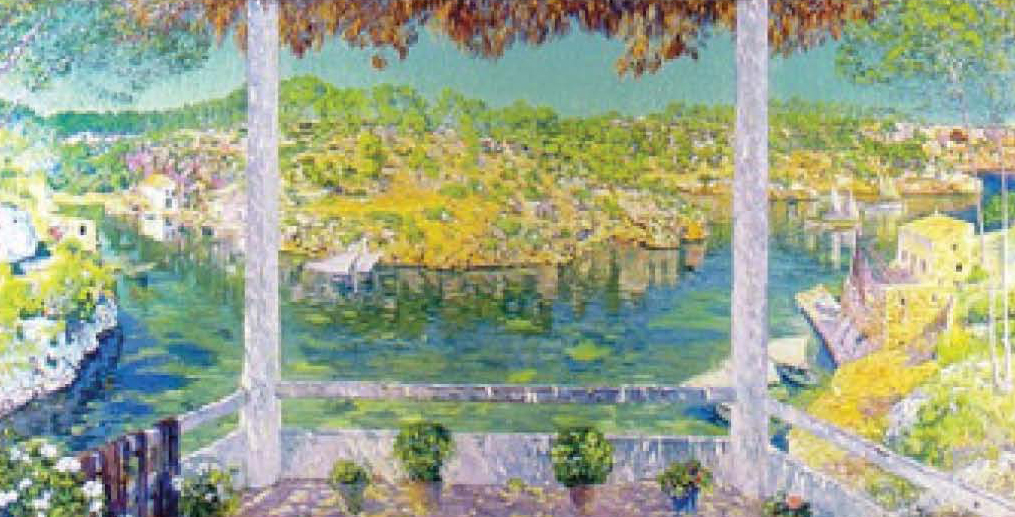
They were celebrating the fiestas for the Virgen del Carmen in Cala Figuera at the weekend. This was the Santanyi Cala Figuera (there are others - Calvia, Pollensa), the name of which owes everything to the fig tree. The sea in the cala, the cove, is deep. The formation, a type of Y-shape between cliffs, is narrow. There was a tiny fishing settlement in the nineteenth century. Development, as such, only started to occur in the mid-twentieth century at around the time when Francisco Bernareggi died.
The fiestas were an occasion for remembering Bernareggi and so for highlighting the contribution of the south-eastern coast of Mallorca to the island's painting tradition. The Tramuntana mountains and Palma are most commonly associated with the painters of the last century. Santanyi played its part as well, though this is often overlooked.
This was the coastal area where Pep Costa Ferrer was instrumental in creating Cala d'Or in the 1930s. Don Pep had a similar vision to Adan Diehl, the founder of Pollensa's Hotel Formentor: a haven of artistic and cultural endeavour. He had at one point considered the same promontory as Diehl. Cala d'Or (what was to be named Cala d'Or, that is) was significantly less expensive. Rather than a single hotel, Don Pep conceived a development, one that famously reflected his Ibizan origins.
But before Costa Ferrer stumbled across the coves that were to inspire his vision, Bernareggi had been hard at work. An Argentine, he first came to Mallorca in 1903 at the age of 25. Other Argentine painters were to arrive in Mallorca, most notably Hermen Anglada Camarasa, attributed with having founded the "Pollensa School". But they came some ten years later than Bernareggi. He was therefore more of a pioneer and as the son of a Catalan he had moved with his family to Barcelona in 1895. He enrolled at the school of fine arts - a peer and friend was Pablo Picasso.
His parents were to later spend long periods in Mallorca. They had a villa - Es Corb Marí - by El Terreno in Palma, one of the most important centres for foreign artists and writers. Bernareggi, following the path of the Catalan painters, such as Santiago Rusiñol, initially chose the Tramuntana for his work, capturing scenes of Sa Calobra and Soller.
It was 1919 when he moved to Santanyi, where he was to live - on and off - until his death in 1959. An exhibition the following year confirmed his arrival on a broader Mallorcan scene. There were to be two particularly famous works. The first, in 1927, was Bonanza. This captured the essence of the cala at a time when there was so little development. The narrow entrance, somewhat forbidding to those unfamiliar with it, can be seen in the background. In the foreground is an imposing pine tree, a natural feature but possibly also a nod in the direction of Pollensa and Costa i Llobera's poem about the pine of Formentor. There is a copy of the painting in the town hall in Santanyi.
The second work, in 1934, is more famous. It is also more vibrant than Bonanza and has a special place in the cala's history because of its name - simply Cala Figuera. The colours and clarity of the work were the product of how Bernareggi went about the painting. From original sketches, he would then paint around noon so that shadows were lessened and he could reveal the full character of his subject. It is a work that was undertaken on the terrace of a summer house that belonged to a pharmacist friend.
Bernareggi returned to Argentina at the outbreak of the Civil War, but he was to return to Mallorca and to resume his work in Cala Figuera. Santanyi town hall, in remembering his contributions, says that it was he who opened the door to other artists who were to create their own compositions of the Santanyi coast. As important as Don Pep and the artistic crowd he attracted to Cala d'Or, Bernareggi displayed a corner of Mallorca that was much less known than the more typical subjects of the Tramuntana.
He was to say of his work in Cala Figuera that it was a cove with soft lines. It was "Hellenic", he noted, granting it a place in distant Mediterranean culture. There were "harmonies in the water" of stones and enamels.
Many were and have been the tributes to his work. One of the more astonishing was in the Spanish newspaper ABC. In 1925, as part of a series on Argentine painters, a profile praised him got the "marvellous transmission of his thoughts through his brushes". His work was "unblemished". It was full of light. It communicated the emotion of nature. And it communicated the little part of paradise he had found at Cala Figuera.
* Photo: Cala Figuera by Francisco Bernareggi.
Showing posts with label Santanyi. Show all posts
Tuesday, July 18, 2017
Monday, March 28, 2016
The Four Poems Of Easter
"To the bells, love. To the bell towers of joy, entertainer. Yes, I would climb. But you will not climb. Not to the bell towers of joy.
"Heaven, as that of Easter, a gate. His body full of blue blows. And on the chest, with the movement of birds. The white moon, now dead. With a strike of the lance, Blai. That never heals.
"To the bells, love. To the bell towers of joy, entertainer. Yes, I would climb. But you will not climb. Not to the bell towers of joy.
"To the coral of gardens. Love open from pomegranates. How close to the distant bells. In the dawn of jasmine. Doves on the sea. To the sticks, pineapples of paschal candles."
These peculiar verses (even allowing for my less than perfect translation) come from "Pasqua Nova"; New Easter, if you like. It is one of four poems of Easter that were published in 1950, the first works to go into print by a poet and writer with whom you are probably unfamiliar but who is considered to be one of the greats of Mallorcan and Catalan literature. His name is Blai Bonet.
In Santanyi's Casa de Cultura, there is a centre devoted to the contemporary poetry of this son of Santanyi. He was born ninety years ago into what was a family of modest means. At a time when education in Mallorca was limited to say the least, he was, by the age of fifteen, conversant with the works of Virgil, Ovid, Plato and Aristotle. He owed it all to the seminary in Palma that he entered at the age of ten and so quite possibly also to the Marquis Barberà, the owner of the finca where his father worked.
He was to turn his back on the priesthood, suffering in different ways: mentally and physically. He was to live with a lung condition, the result of tuberculosis, while something of an existential crisis when he was still young - only 21 - caused confused attitudes to religion and led him to embark on a career as a writer.
"The Four Poems Of Easter", one of the works he was to write while in a sanatorium for his TB, reflects some of Bonet's struggles. In "Pasqua Nova" he talks to himself, blending curious natural imagery with allusions to Christ on the cross. His references to nature, commentators suggest, were mostly drawn from Santanyi, and not least from the coast and the sea: one of his greatest works, started while he was in the sanatorium, was "El Mar". Fifty years after he had embarked on the writing of this novel, it was made into a film. Agusti Villaronga, the Mallorcan director, described it variously as sordid, illuminating, beautiful, haunting, poetic and full of love for its characters. He also spoke, and Bonet had now been dead for three years (he died in Santanyi), about the attitude to religion, to the riddle of existence and to struggles in confronting death. In essence, and Villaronga could have been talking about "The Four Poems Of Easter" as well, Bonet was constantly fearful of his mortality, the consequence of his illness. He lived his life expecting to die.
Though celebrated among the ranks of the Catalan literati and though also enjoying a good career, his condition was such that his doctors advised him to settle again in Santanyi (he had been, among other places, in Barcelona and Germany). The climate, it was felt, would be best for him. This was in 1972, and he went into what was a semi-retirement. His work and he himself began to be forgotten, but he was to return in 1987 with a book of poems called "The Young". He received numerous awards, including the Balearic Ramon Llull prize (posthumously in 1998).
The rediscovery of Bonet was to lead critics to place him on a high pedestal indeed. One has compared him with James Joyce in that stylistically he was an innovator in avant-garde literature. There is also the story of how the musician Lou Reed attended an event devoted to Catalan poets that was led by other musicians, Patti Smith and Laurie Anderson, and chose one of these poems to recite himself. Its title is "All Brow" from a collection by Bonet called "Nova York". All Brow was in fact a Panamanian boxer Al Brown, the first Latin American boxer to become a world champion.
Bonet is one of the writers celebrated in the Walking on Words project that has seven routes that combine walking with the life, the times and the works of major names in Mallorca's literature. And in the south-east corner of the island, Santanyi is a town that can boast its own strong literary, cultural and artistic tradition. It was here, on the coast, where Josep Costa Ferrer (Don Pep), painter, caricaturist and writer, was to create Cala d'Or, originally a haven for artists and writers. And it was here where Blai Bonet saw the sea: El Mar.
"Heaven, as that of Easter, a gate. His body full of blue blows. And on the chest, with the movement of birds. The white moon, now dead. With a strike of the lance, Blai. That never heals.
"To the bells, love. To the bell towers of joy, entertainer. Yes, I would climb. But you will not climb. Not to the bell towers of joy.
"To the coral of gardens. Love open from pomegranates. How close to the distant bells. In the dawn of jasmine. Doves on the sea. To the sticks, pineapples of paschal candles."
These peculiar verses (even allowing for my less than perfect translation) come from "Pasqua Nova"; New Easter, if you like. It is one of four poems of Easter that were published in 1950, the first works to go into print by a poet and writer with whom you are probably unfamiliar but who is considered to be one of the greats of Mallorcan and Catalan literature. His name is Blai Bonet.
In Santanyi's Casa de Cultura, there is a centre devoted to the contemporary poetry of this son of Santanyi. He was born ninety years ago into what was a family of modest means. At a time when education in Mallorca was limited to say the least, he was, by the age of fifteen, conversant with the works of Virgil, Ovid, Plato and Aristotle. He owed it all to the seminary in Palma that he entered at the age of ten and so quite possibly also to the Marquis Barberà, the owner of the finca where his father worked.
He was to turn his back on the priesthood, suffering in different ways: mentally and physically. He was to live with a lung condition, the result of tuberculosis, while something of an existential crisis when he was still young - only 21 - caused confused attitudes to religion and led him to embark on a career as a writer.
"The Four Poems Of Easter", one of the works he was to write while in a sanatorium for his TB, reflects some of Bonet's struggles. In "Pasqua Nova" he talks to himself, blending curious natural imagery with allusions to Christ on the cross. His references to nature, commentators suggest, were mostly drawn from Santanyi, and not least from the coast and the sea: one of his greatest works, started while he was in the sanatorium, was "El Mar". Fifty years after he had embarked on the writing of this novel, it was made into a film. Agusti Villaronga, the Mallorcan director, described it variously as sordid, illuminating, beautiful, haunting, poetic and full of love for its characters. He also spoke, and Bonet had now been dead for three years (he died in Santanyi), about the attitude to religion, to the riddle of existence and to struggles in confronting death. In essence, and Villaronga could have been talking about "The Four Poems Of Easter" as well, Bonet was constantly fearful of his mortality, the consequence of his illness. He lived his life expecting to die.
Though celebrated among the ranks of the Catalan literati and though also enjoying a good career, his condition was such that his doctors advised him to settle again in Santanyi (he had been, among other places, in Barcelona and Germany). The climate, it was felt, would be best for him. This was in 1972, and he went into what was a semi-retirement. His work and he himself began to be forgotten, but he was to return in 1987 with a book of poems called "The Young". He received numerous awards, including the Balearic Ramon Llull prize (posthumously in 1998).
The rediscovery of Bonet was to lead critics to place him on a high pedestal indeed. One has compared him with James Joyce in that stylistically he was an innovator in avant-garde literature. There is also the story of how the musician Lou Reed attended an event devoted to Catalan poets that was led by other musicians, Patti Smith and Laurie Anderson, and chose one of these poems to recite himself. Its title is "All Brow" from a collection by Bonet called "Nova York". All Brow was in fact a Panamanian boxer Al Brown, the first Latin American boxer to become a world champion.
Bonet is one of the writers celebrated in the Walking on Words project that has seven routes that combine walking with the life, the times and the works of major names in Mallorca's literature. And in the south-east corner of the island, Santanyi is a town that can boast its own strong literary, cultural and artistic tradition. It was here, on the coast, where Josep Costa Ferrer (Don Pep), painter, caricaturist and writer, was to create Cala d'Or, originally a haven for artists and writers. And it was here where Blai Bonet saw the sea: El Mar.
Tuesday, June 16, 2015
A Day In Mallorca Three Hundred Years Ago
This coming Saturday at 9am an excursion has been arranged. It will take the trippers from the Cami Jesus in Palma to the south-east of the island. It has been arranged by the association of friends of the Museum of Mallorca and those going on the trip will hear about Cala d'Or - the name which "Don Pep" Costa Ferrer gave the one-time Cala d'Hort - and will visit Cala Llonga, the "curious" church of S'Horta, Felanitx and then, having had some wine, some ensaimada, some meats and sausages (courtesy of the local co-operative), they will be back in Santanyi to take in S'Alqueria Blanca and finally Calonge.
This is not an excursion that one suspects will attract many, if any tourists, but it is a day out which, nonetheless, would prove highly illuminating for anyone (including tourists) with an interest in Mallorca's history: would do, except that it will all be in Mallorquín no doubt.
Though the excursion is on 20 June, its purpose is to mark an event which happened 300 years ago on 16 June 1715. The title of the excursion is "Calonge 1715, a battle to save dignity". On that day 300 years ago the battle of Calonge took place. It was one that had far-reaching consequences for Mallorca.
The War of the Spanish Succession finally put paid to the kingdom of Mallorca, which had only been a notional kingdom for centuries but had retained a title of administrative kingdom tied in with the Crown of Aragon and ultimately with the Crown of Spain. The war brought an end to this. The Crown of Aragon was abolished and the kingdom of Mallorca definitively and for all time disappeared along with it.
The dismantling of the Crown of Aragon, the removal of privileges that Catalonia had and the creation of a centralised Spanish state were the consequence of the Nueva Planta decrees of the first Bourbon king of Spain, Philip V. They were also his revenge. The Crown of Aragon, and so Catalonia, Valencia and Mallorca, had sided with Charles VI, the Holy Roman Emperor, during the war. Once Spain was left to its own devices at the end of the war, Philip, with French help, set about the submission of Aragon and the creation of a single Spanish state. The war was, and I quote one source, "a world war of a colonial character with the subjugation on the part of Bourbon Castile, with the decisive military support of the French army, of the Catalan Nation". The far-reaching consequences have never been forgotten: they inform the current-day arguments regarding Catalan and nationalism of the Catalan Lands.
Nine months before the battle of Calonge the city of Barcelona had finally fallen, having been under siege by Bourbon troops for more than a year. The advance on Mallorca was, in effect, a mopping-up operation to eliminate any remaining resistance to Philip. The south-east of Mallorca had played a significant part in the siege, as Felanitx was a major supplier to the people of the city who were trapped by the Bourbon forces. Felanitx and other parts of Mallorca were Barcelona's food suppliers, a fact that was reflected in a saying of the time - "the Mallorcan pantry is coming".
When Barcelona fell in September 1714 it was clear that Mallorca was going to be a target. The Marquès Josep Antoni de Rubí i de Boixadors had been made the new viceroy of Mallorca in 1713. He decided that the island would not surrender. Instead, it would defend itself. In early 1715 there were demonstrations of support for this stance and against the Bourbons. Ceremonies of blessings of flags occurred in Palma and various villages, Felanitx included. The Marquès de Palmer was placed in charge of the south-eastern region of Felanitx, Santanyi and Campos. Felanitx could count on 400 men to counter any attack. Palmer got hold of 300 new shotguns.
On 11 June a force of 30,000 troops set sail from Barcelona. An initial assault on Santa Ponsa was, remarkably enough, rebuffed. The force split into two. One was to land in the bay of Alcúdia, the other in the south-east. On 15 June the Spanish-French army landed at Cala Llonga, Cala Figuera and Cala Ferrera. The next day the full artillery landed. The invasion had begun and at Calonge a small army of six hundred confronted the Bourbon forces. The battle didn't last long.
There were of course deaths and there was also plunder, but it would seem that there wasn't great bloodshed. The Marquès de Rubí surrendered on 2 July in order to spare Palma. The repression started immediately, though references to genocide are greatly exaggerated. The battle of Calonge had been one for dignity and in some respects - 300 years on - there is still a battle for that dignity.
This is not an excursion that one suspects will attract many, if any tourists, but it is a day out which, nonetheless, would prove highly illuminating for anyone (including tourists) with an interest in Mallorca's history: would do, except that it will all be in Mallorquín no doubt.
Though the excursion is on 20 June, its purpose is to mark an event which happened 300 years ago on 16 June 1715. The title of the excursion is "Calonge 1715, a battle to save dignity". On that day 300 years ago the battle of Calonge took place. It was one that had far-reaching consequences for Mallorca.
The War of the Spanish Succession finally put paid to the kingdom of Mallorca, which had only been a notional kingdom for centuries but had retained a title of administrative kingdom tied in with the Crown of Aragon and ultimately with the Crown of Spain. The war brought an end to this. The Crown of Aragon was abolished and the kingdom of Mallorca definitively and for all time disappeared along with it.
The dismantling of the Crown of Aragon, the removal of privileges that Catalonia had and the creation of a centralised Spanish state were the consequence of the Nueva Planta decrees of the first Bourbon king of Spain, Philip V. They were also his revenge. The Crown of Aragon, and so Catalonia, Valencia and Mallorca, had sided with Charles VI, the Holy Roman Emperor, during the war. Once Spain was left to its own devices at the end of the war, Philip, with French help, set about the submission of Aragon and the creation of a single Spanish state. The war was, and I quote one source, "a world war of a colonial character with the subjugation on the part of Bourbon Castile, with the decisive military support of the French army, of the Catalan Nation". The far-reaching consequences have never been forgotten: they inform the current-day arguments regarding Catalan and nationalism of the Catalan Lands.
Nine months before the battle of Calonge the city of Barcelona had finally fallen, having been under siege by Bourbon troops for more than a year. The advance on Mallorca was, in effect, a mopping-up operation to eliminate any remaining resistance to Philip. The south-east of Mallorca had played a significant part in the siege, as Felanitx was a major supplier to the people of the city who were trapped by the Bourbon forces. Felanitx and other parts of Mallorca were Barcelona's food suppliers, a fact that was reflected in a saying of the time - "the Mallorcan pantry is coming".
When Barcelona fell in September 1714 it was clear that Mallorca was going to be a target. The Marquès Josep Antoni de Rubí i de Boixadors had been made the new viceroy of Mallorca in 1713. He decided that the island would not surrender. Instead, it would defend itself. In early 1715 there were demonstrations of support for this stance and against the Bourbons. Ceremonies of blessings of flags occurred in Palma and various villages, Felanitx included. The Marquès de Palmer was placed in charge of the south-eastern region of Felanitx, Santanyi and Campos. Felanitx could count on 400 men to counter any attack. Palmer got hold of 300 new shotguns.
On 11 June a force of 30,000 troops set sail from Barcelona. An initial assault on Santa Ponsa was, remarkably enough, rebuffed. The force split into two. One was to land in the bay of Alcúdia, the other in the south-east. On 15 June the Spanish-French army landed at Cala Llonga, Cala Figuera and Cala Ferrera. The next day the full artillery landed. The invasion had begun and at Calonge a small army of six hundred confronted the Bourbon forces. The battle didn't last long.
There were of course deaths and there was also plunder, but it would seem that there wasn't great bloodshed. The Marquès de Rubí surrendered on 2 July in order to spare Palma. The repression started immediately, though references to genocide are greatly exaggerated. The battle of Calonge had been one for dignity and in some respects - 300 years on - there is still a battle for that dignity.
Thursday, July 31, 2014
Tales Of The Llevant: The Belgians
Belgians might seem unlikely contributors to Mallorca's tourism history. It's not as if one hears a great deal about the importance of the Belgian market nowadays; in fact, you don't hear anything about it. But Belgians there most definitely were. The most celebrated was Gerard Blitz because of his original 1950 tented Club Med village on the beach of the French in Alcúdia. Club Med were to eventually transfer operations and create a permanent base on the island's south-east coast. The only Club Med in Mallorca lasted in Portopetro until 2001.
Portopetro is all but a continuation of its neighbour just to its north, Cala d'Or, the two resorts being part of a string of generally understated touristic inhabitation that includes the calas of Figuera, Santanyi and Llombards, separated by the Mondragó park. And it was in Cala d'Or that the Belgian connection was made and was to be crucial to the resort's early development.
But before the Belgians, there was an Ibizan. Josep Costa Ferrer, aka Picarol, aka Don Pep, a painter, cartoonist and publisher. At the start of the 1930s, he turned up in Ses Puntetes and bought fifteen "quarterades" from Catalina Adrover de Calonge (a quarterada is a measurement of land equivalent to slightly more than 0.7 of a hectare and so roughly 7,000 square metres). He paid 1,000 pesetas for each quarterada. He got a bargain and proceeded to establish a coastal urbanisation which he named after a cala from his native Ibiza - Cala d'Hort. The name was quickly corrupted. It became Cala d'Or. The orchard cove became the gold cove.
The story of Cala d'Or and of its development is one about which we have more first-hand knowledge than of any of the other inter-war coastal developments in Mallorca. It is a story not without its glamour on account of names of those who came and bought properties; Rudolf Valentino's one-time wife was just one. The richness of the story is due to the fact that it was well chronicled, and the person who chronicled it was Don Pep himself.
Yet, despite the various articles that Don Pep wrote, there are discrepancies and elements missing. For example, the price he paid for the land was also reported as having been 13,000 pesetas in total. It might not matter - it was still incredibly cheap even for those days - but it is an indication of how these stories and histories have become mangled. Then there is the story of the Belgians. The accepted wisdom is that a Sr. Van Crainest and a Medard Verburgh were the principal developers of Cala d'Or. It is a wisdom which is true, but what is never explained, and even Don Pep didn't explain, was their backstory.
Van Crainest is only ever referred to by his surname. I can find no reference to his Christian name, while the surname is almost certainly spelt incorrectly. Van Craeynest is the normal spelling. He was described (only ever described) as having been an important "bodeguero", a literal translation of which is grocer but which can mean other things, such as a keeper of a wine cellar. It is probably more accurate to say that his business was that in the French tradition of the epicerie, a grocery store for sure, but way more than that, including the sale of fine wines.
But why did Van Crainest come to Mallorca? The only explanation seems to be that Verburgh invited him, and so who was Verburgh, and what was he doing in Mallorca? He was a painter, but what drew him to Santanyi and to Don Pep? The answer, I suspect, lies on the other side of the island. Don Pep had originally intended to establish a sort of haven along the Formentor promontory, where land prices were vastly higher. In 1931, following a well-established pattern of artists staying in Puerto Pollensa, Verburgh took up residence in the Hotel Miramar, having come from the US to seek inspiration, as did so many other artists, from Mallorca's light and landscapes. Don Pep definitely knew the likes of Adan Diehl, who had founded the Hotel Formentor, and so would have known various artists. Verburgh was almost certainly one of them, and Verburgh was not just a painter, he was also the youngest son of a family that had a grocery business (or an epicerie). Van Crainest, it can probably be assumed, either had a business association with the Verburgh family or was indeed a member of the wider family.
There is nothing sinister in any of this, simply a bit of mystery. Much of Mallorca's tourism history has a distinct starting-point but little or nothing that explains what brought about the starting-point. This is the case with Cala d'Or. The Belgians arrived, started developing and the rest was history. There was rather more to it than that.
Index for July 2014
Alcúdia old well - 18 July 2014
Alcúdia Via Fora - 13 July 2014
Anti-bullfighting campaign - 27 July 2014
Bad image and reaction - 3 July 2014
Bauzá Assemblea de Docents rap video - 19 July 2014
Belgians in Cala d'Or - 31 July 2014
Cala Bona and 1920s' roots - 29 July 2014
Cala Ratjada and Joan March - 28 July 2014
Cala Ratjada and Manacor-Artà train - 23 July 2014
Citizen participation and opinion - 2 July 2014
Holiday lets - 4 July 2014, 24 July 2014
How war shaped Mallorca's tourism development - 20 July 2014
Jaume Matas prison - 14 July 2014
Magalluf fellatio video - 5 July 2014, 7 July 2014, 11 July 2014, 12 July 2014, 26 July 2014
Mallorca like Brazil - 10 July 2014
Mallorca's tourism: how it might have been - 20 July 2014, 21 July 2014, 22 July 2014
Mediterranean winds - 16 July 2014
Naturism and anarchy - 8 July 2014
Patrona and Pollensa Festival - 25 July 2014
Pedro Sánchez - 15 July 2014
Pickpocketing - 1 July 2014
Pregón of fiestas - 6 July 2014
Scandals and PR disasters - 9 July 2014
S'Illot tourism development - 30 July 2014
Tourism, summer 2014 - 17 July 2014
Winds - 16 July 2014
Portopetro is all but a continuation of its neighbour just to its north, Cala d'Or, the two resorts being part of a string of generally understated touristic inhabitation that includes the calas of Figuera, Santanyi and Llombards, separated by the Mondragó park. And it was in Cala d'Or that the Belgian connection was made and was to be crucial to the resort's early development.
But before the Belgians, there was an Ibizan. Josep Costa Ferrer, aka Picarol, aka Don Pep, a painter, cartoonist and publisher. At the start of the 1930s, he turned up in Ses Puntetes and bought fifteen "quarterades" from Catalina Adrover de Calonge (a quarterada is a measurement of land equivalent to slightly more than 0.7 of a hectare and so roughly 7,000 square metres). He paid 1,000 pesetas for each quarterada. He got a bargain and proceeded to establish a coastal urbanisation which he named after a cala from his native Ibiza - Cala d'Hort. The name was quickly corrupted. It became Cala d'Or. The orchard cove became the gold cove.
The story of Cala d'Or and of its development is one about which we have more first-hand knowledge than of any of the other inter-war coastal developments in Mallorca. It is a story not without its glamour on account of names of those who came and bought properties; Rudolf Valentino's one-time wife was just one. The richness of the story is due to the fact that it was well chronicled, and the person who chronicled it was Don Pep himself.
Yet, despite the various articles that Don Pep wrote, there are discrepancies and elements missing. For example, the price he paid for the land was also reported as having been 13,000 pesetas in total. It might not matter - it was still incredibly cheap even for those days - but it is an indication of how these stories and histories have become mangled. Then there is the story of the Belgians. The accepted wisdom is that a Sr. Van Crainest and a Medard Verburgh were the principal developers of Cala d'Or. It is a wisdom which is true, but what is never explained, and even Don Pep didn't explain, was their backstory.
Van Crainest is only ever referred to by his surname. I can find no reference to his Christian name, while the surname is almost certainly spelt incorrectly. Van Craeynest is the normal spelling. He was described (only ever described) as having been an important "bodeguero", a literal translation of which is grocer but which can mean other things, such as a keeper of a wine cellar. It is probably more accurate to say that his business was that in the French tradition of the epicerie, a grocery store for sure, but way more than that, including the sale of fine wines.
But why did Van Crainest come to Mallorca? The only explanation seems to be that Verburgh invited him, and so who was Verburgh, and what was he doing in Mallorca? He was a painter, but what drew him to Santanyi and to Don Pep? The answer, I suspect, lies on the other side of the island. Don Pep had originally intended to establish a sort of haven along the Formentor promontory, where land prices were vastly higher. In 1931, following a well-established pattern of artists staying in Puerto Pollensa, Verburgh took up residence in the Hotel Miramar, having come from the US to seek inspiration, as did so many other artists, from Mallorca's light and landscapes. Don Pep definitely knew the likes of Adan Diehl, who had founded the Hotel Formentor, and so would have known various artists. Verburgh was almost certainly one of them, and Verburgh was not just a painter, he was also the youngest son of a family that had a grocery business (or an epicerie). Van Crainest, it can probably be assumed, either had a business association with the Verburgh family or was indeed a member of the wider family.
There is nothing sinister in any of this, simply a bit of mystery. Much of Mallorca's tourism history has a distinct starting-point but little or nothing that explains what brought about the starting-point. This is the case with Cala d'Or. The Belgians arrived, started developing and the rest was history. There was rather more to it than that.
Index for July 2014
Alcúdia old well - 18 July 2014
Alcúdia Via Fora - 13 July 2014
Anti-bullfighting campaign - 27 July 2014
Bad image and reaction - 3 July 2014
Bauzá Assemblea de Docents rap video - 19 July 2014
Belgians in Cala d'Or - 31 July 2014
Cala Bona and 1920s' roots - 29 July 2014
Cala Ratjada and Joan March - 28 July 2014
Cala Ratjada and Manacor-Artà train - 23 July 2014
Citizen participation and opinion - 2 July 2014
Holiday lets - 4 July 2014, 24 July 2014
How war shaped Mallorca's tourism development - 20 July 2014
Jaume Matas prison - 14 July 2014
Magalluf fellatio video - 5 July 2014, 7 July 2014, 11 July 2014, 12 July 2014, 26 July 2014
Mallorca like Brazil - 10 July 2014
Mallorca's tourism: how it might have been - 20 July 2014, 21 July 2014, 22 July 2014
Mediterranean winds - 16 July 2014
Naturism and anarchy - 8 July 2014
Patrona and Pollensa Festival - 25 July 2014
Pedro Sánchez - 15 July 2014
Pickpocketing - 1 July 2014
Pregón of fiestas - 6 July 2014
Scandals and PR disasters - 9 July 2014
S'Illot tourism development - 30 July 2014
Tourism, summer 2014 - 17 July 2014
Winds - 16 July 2014
Subscribe to:
Posts (Atom)
